Critics Say Carbon Pricing Models Miss Rural and Industrial Realities
10/30/2026 / By Sterling Ashworth

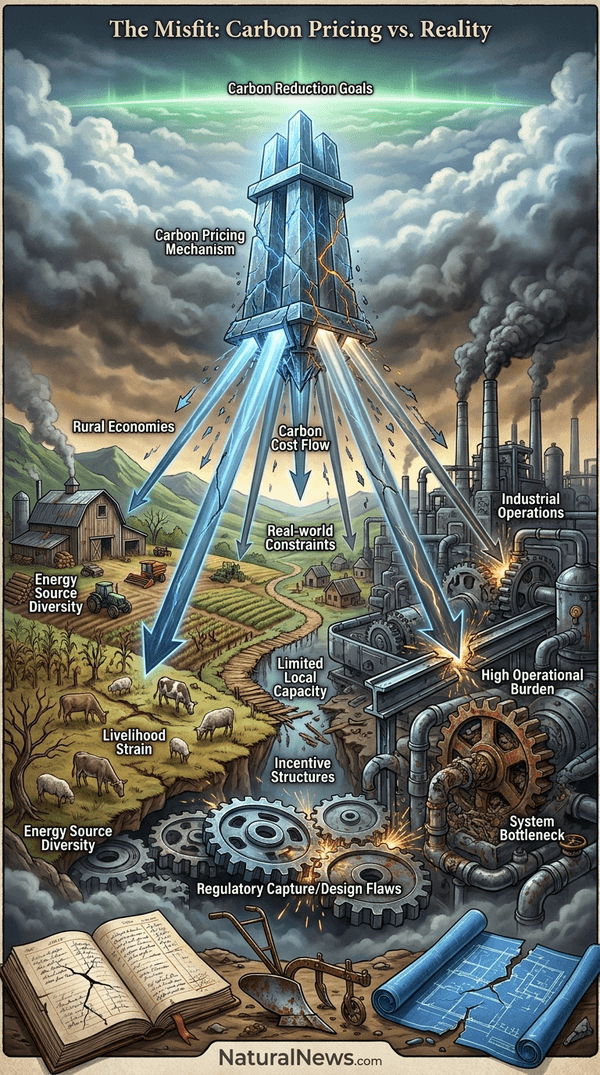
Carbon pricing has long been promoted by economists and climate advocates as a cost-effective way to reduce greenhouse gas emissions, but critics said the approach assumes that practical, low-cost alternatives to fossil fuels exist across all economies and geographies.
The dispute is not confined to academic journals. That gap between expert consensus and public acceptance forms the backdrop for a growing body of criticism that questions whether carbon pricing models accurately represent rural and industrial energy demands.
Critics said the models often treat emissions reductions as a matter of price signals alone, without accounting for whether substitutes are available in specific places and sectors. Economists have argued that internalizing the external costs of carbon into fuel prices is the central solution to the climate crisis [1], but critics contended that the framework works best on paper and less well on a farm or in a factory.
Carbon Prices Rely on Available Substitutes, Critics Say
According to critics, a carbon price can drive large emissions cuts only when low-cost alternatives exist. Where alternatives are limited, high prices face political resistance and may cost more than other strategies. The argument is a matter of substitution: When electric vehicles are near-perfect substitutes for gasoline cars, zero-emission vehicle standards or feebates may achieve reductions at little cost, according to the critique.
When no viable alternative exists, a standard may be impossible to meet, while a carbon price at least encourages less driving and more efficient vehicles. Supporters of carbon pricing say it can influence millions of drivers at once.
In contrast, critics said that approach effectively taxes existing gasoline vehicle owners to affect a smaller group of new-car buyers. They also pointed out that the substitution problem extends beyond cars. They argued that carbon pricing models assume a flexibility that many rural and industrial energy users do not have, and that the models understate the cost of switching when infrastructure and machinery are built around fossil fuels.
Rural and Industrial Energy Demands Limit Options
In rural areas, critics said lightweight vehicles and electric vehicles face safety risks from animal collisions. One account described a heavy-duty four-wheel-drive vehicle surviving a feral hog impact that lifted the vehicle 30 degrees, while electric vehicle batteries are more vulnerable to impact damage.
A farmer in the city of Orange in Australia’s New South Wales state uses 1,000 liters of fuel per day in peak season and relies on fertilizer and agricultural chemicals on a small secondary-income farm, according to the critique, and the infrastructure needed for electric replacements is not expected soon.
Industrial users said trade tools and manufacturing require high power, and in many cases fossil fuel is the only viable energy form. Critics said pricing carbon may reduce economic activity rather than produce innovation. The concern echoes a broader finding that the use of fossil fuels will continue at current or higher levels unless their relative price is increased, and that increased energy prices change the basis for energy-saving measures and alternative energy production systems [2].
Rural energy planning research has emphasized decentralized approaches that match local resources and constraints, rather than one-size-fits-all market instruments [3]. Critics said carbon pricing models seldom incorporate that local variability, and that the result is a policy that looks efficient in aggregate but imposes disproportionate costs on places with few substitutes.
Carbon Leakage Shifts Emissions Rather Than Reducing Them
The European Union calls the relocation of business due to emissions pricing “carbon leakage,” according to the critique. Australia’s manufacturing industry has fallen 50% while the country ships coal and raw materials to Asia and imports finished products. California has lost heavy industrial jobs to other states, and data centers serving California tech companies are being built outside the state, according to the critique, which said emissions are relocated rather than significantly reduced.
Global carbon dioxide measurements cited in the critique indicate that emissions reduction policies have shifted emissions and industrial activity to China. China’s total emissions of carbon dioxide from coal-fired power generation hit an all-time high of 5.56 billion metric tons in 2023, nearly 6% greater than the previous record set in 2022, according to a report published by Climate Depot [4]. Critics said relocating emissions is cheaper than reducing them, even with a carbon border adjustment tax.
The leakage argument challenges the core claim that carbon pricing lowers global emissions. If production and its associated emissions move to jurisdictions without a carbon price, the policy may reduce measured emissions at home while leaving the global total largely unchanged.
Technological Breakthrough Cited as Prerequisite
Until a significant technological breakthrough occurs, such as compact devices that power anything from plastic or organic scrap, critics said meaningful emissions reductions hurt the economy making the attempt and transfer emissions elsewhere. The critique stated that current policies may affect limited areas, but the easiest way to cut carbon dioxide emissions is to close a factory or abandon a farm, and business owners have made such decisions.
Critics concluded that without breakthrough technology, carbon pricing and efficiency standards do not deliver large reductions and instead shift economic activity and emissions to other jurisdictions. The argument places the burden of proof on advocates of market-based climate policy: until substitutes are cheap and practical everywhere, a carbon price may redistribute emissions rather than eliminate them.
References
- Economists and the climate. https://www.sciencedirect.com/science/article/pii/S2214804323001842
- Bioenergy from sustainable forestry guiding principles and practice. Unknown
- Decentralized energy planning; modeling and application—a review. Elsevier. Renewable and Sustainable Energy Reviews 11 (2007) 729–752
- China continues to rely on coal while pushing expensive renewable energy and EVs on America – NaturalNews.com, May 09, 2024.
Explainer Infographic
Submit a correction >>
Tagged Under:
big government, carbon dioxide, carbon emissions, carbon pricing, Climate, climate change, electric cars, energy supply, fuel supply, Green New Deal, green tyranny, industrial realities, new energy, pricing model, rural realities, truth
This article may contain statements that reflect the opinion of the author
RECENT NEWS & ARTICLES